Dufenhof Swissies
Dufenhof Swissies
Rixeyville, VA 22737
United States
Frequently Asked Questions
- How Big Will A Swissy Get?
Swissies are the largest of the four Swiss Sennenhund. The males generally weigh between 105-140 lb. and stand approximately 25-28 inches at the shoulder. Females are slightly smaller and weigh between 80-110 lb. and are 23-27 inches tall at the shoulder. Each dog is different, your breeder and veterinarian can help you decide what weight is appropriate for your individual dog. Swissies are slow to mature and usually do not reach their full size until they are 1 1/2 - 3 years old.
- What is their temperament like?
Swissies are naturally confident, friendly dogs who are happiest when spending time with their families. They should be neither fearful nor aggressive. Proper socialization from an early age is very important. Most Swissy puppies are very active but as adults they are generally calm dogs who require a moderate amount of exercise.
- Are Swissies easy to train?
Swissies generally respond best to firm but gentle training using positive reinforcement methods rather than physical punishment or heavy corrections. They can be stubborn at times but generally are eager to please, thriving on attention and praise. 'Clicker' training or food training usually works quite well for most Swissies.
- What type of health problems do Swissies have?
Swissies share the same health concerns as other large breeds, such as dysplasia (hip & elbow), Osteochondritis dessicans (OCD) of the shoulder and bloat, as well as epilepsy and entropian(eyes). Swissies are also known to be prone to Splenic Torsion.
To reduce the risk of having a dog afflicted with either hip or elbow dysplasia it is important that both parents have had there hips and elbows certified by the Orthopedic Foundation for Animals (OFA). You should always verify that both the sire and dam have OFA #s go to www.offa.org to search their open database. You will need the registered names of the dogs you are checking on.
OCD is a condition affecting the shoulders that may be a genetic condition. If a parent has OCD there may be an increased chance of a dog developing this condition. You should be aware that hip replacement surgery or the surgery to correct OCD generally cost in excess of $1000.
- What is Bloat?
What is commonly referred to as Bloat is Gastric Dilitation-Volvulus. The dogs stomach fills with air, swells up and then torses. The torsing (or twisting) cuts off the blood and oxygen supply to vital organs and unless the dog is given immediate medical treatment death will occur. Bloat is seen in all breeds with deep chests it is and especially in the larger breeds. All Swissy owners MUST take the time to learn about bloat prevention and treatment.
- What type of food and how much does a Swissy eat?
Generally speaking, an adult Swissy will eat about one 40lb bag of premium dog food each month. Swissies should be fed a low protein, high quality food throughout their lifetime including puppyhood. Too high a protein level can cause too rapid a growth rate thereby possibly causing some growth related problems. Swissies should never be allowed to get fat since this can cause undue strain on their joints and other will impair their health.
- Do Swissies drool?
No. Swissies are considered a dry-mouthed breed and do not drool any more than Labradors or Collies.
- Do they shed?
Yes. Although shorthaired, Swissies have a thick ‘double’ coat. Most Swissies will shed heavily in the spring when they lose their thick undercoat. Regular brushing and occasional bathing will help to reduce the amount of hair shed throughout the year, but some shedding will still occur.
- Are they good with children?
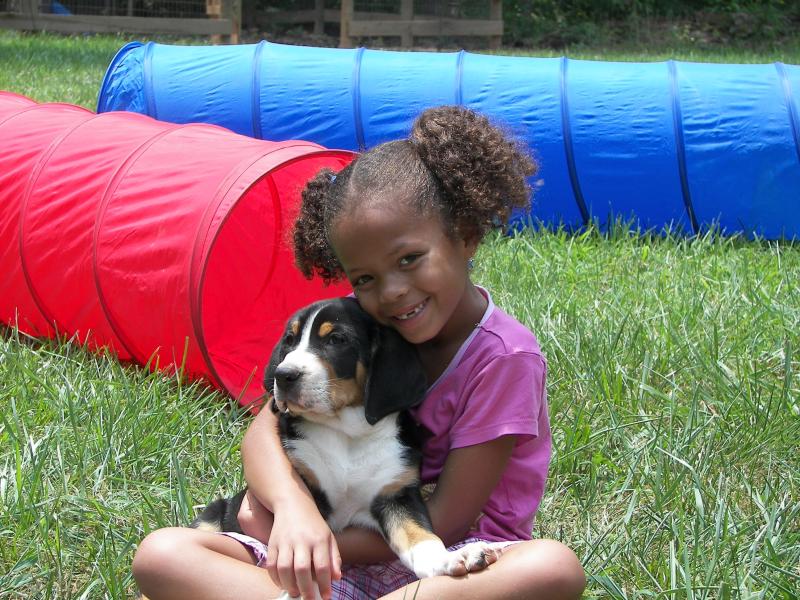
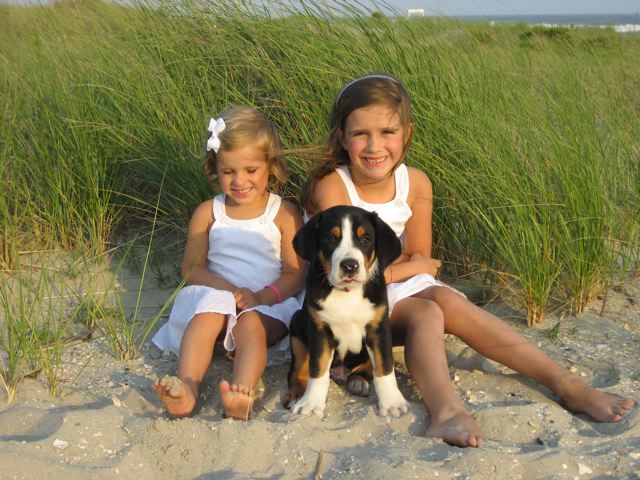
Swissies can make wonderful family pets but as with any breed they cannot be expected to be good with children unless they have been raised that way. Likewise, children should be taught from an early age to respect your dog and treat them with kindness. Even though Swissies are usually very gentle dogs they are a large breed and must be supervised when playing with children.
- Are they good with other pets/animals?
Swissies should be able to get a long well with other dogs as well as many other animals. Proper socialization to other animals is just as important as socialization to people and should begin at an early age. It is recommended that you enroll your Swissy in classes where they can meet new dogs as well as learn basic household obedience. If raised with cats or other animals most Swissies should not have a problem with them.
- How much space do they require--a big yard?
Actually Swissies do not need as much outdoor space as some smaller dogs do. The typical suburban yard is adequate for most Swissies. Swissies are indoor dogs and do not like to be left outside alone for extended periods of time. They prefer to be with their families whether indoors or out. A fence is important and many breeders will require you to have one. Due to the size of an adult Swissy a four to six foot high fence is recommended.
- How much exercise do they need?
Normal puppy play should be enough exercise for a young Swissy. As adults Swissies do need regular exercise but it can be as simple as a walk in the evening or a game of fetch in the backyard. The important thing is to make sure that they get enough exercise without overdoing it. Because they are still growing it is inadvisable to jog with your Swissy until it is mature.
- Do they chew?
All puppies chew. As adults Swissies are not generally 'chewers'. They are usually quite content with a variety of safe chew toys like large Nylabones or Vermont Chewmen.
- Do they bark?
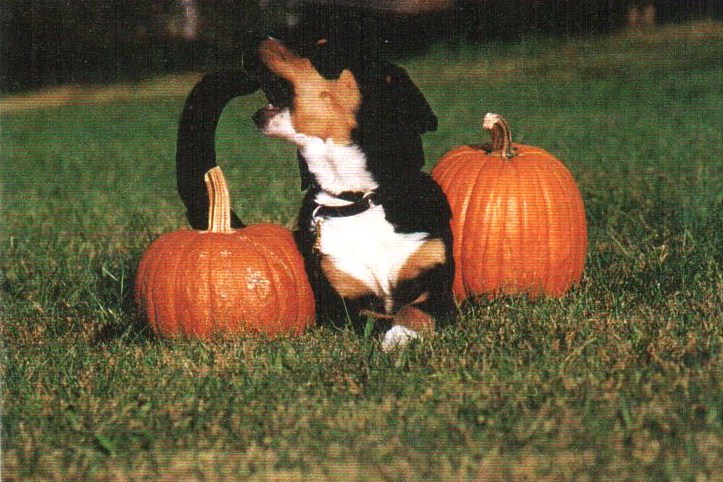
Each dog is different but in general Swissies are not known as bad barkers. Swissies are quick to bark at anything new and different in their environment such as a car in the driveway or a delivery truck. They can also have a 'calling' bark where they will bark in order to get people to pay attention to them.
- Are they easy to housetrain?
Swissy puppies can take a long time to housetrain. It is not at all uncommon for it to take until the dog is 7-9 months old before being really house trained (ie, accident-free when loose in the house). Most puppies can be crate trained by 3-5 months and this will help in the overall process of house training. Swissies take a very long time to physically and mentally mature and as a result they can take longer to house train.
Copyright Ellyn Signet, 1995-2012
All Rights Reserved
I hope that this FAQ will answer some of the basic questions and concerns you may have about the breed. These questions represent the things I am most often asked by those curious about the breed. However, there is no way to cover everything, so please feel free to contact me to ask more questions or if you would like me clarify something. - Ellyn
Copyright 2022 Dufenhof Swissies. All rights reserved (really).
Dufenhof Swissies
Rixeyville, VA 22737
United States